Seamless gutter installation in Gainesville, GA, formed in your driveway
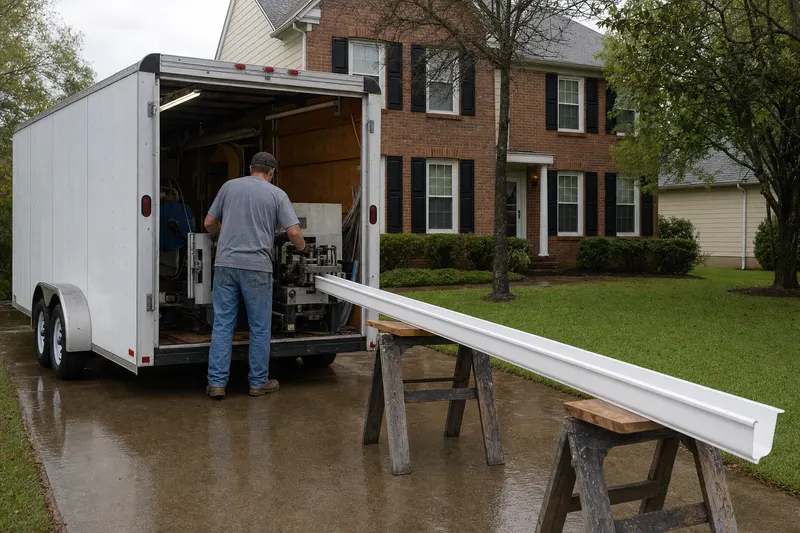
New gutters are made on site. A machine in the trailer forms each run from a coil of aluminum in one piece, cut to the inch for your roofline, so the only joints are at the corners. The installers we send size the gutters and downspouts for the roof above them, and you get the footage, the sizes and the price in writing first.
If it goes to voicemail, leave your name, your street and what the gutters are doing. You get a call back.
Get a free estimate
Four lines. You get a call back at the number you leave.
Faster by phone: (678) 343-2880
How seamless gutters are made and hung
- The roofline is measured, and every run is sketched with its downspout locations.
- The old gutter comes down and the fascia is checked. Soft boards are replaced now, not covered.
- Each run is formed from coil in the driveway and carried up in one piece.
- It is hung on hidden hangers screwed into the fascia and pitched toward the downspouts.
- Corners are mitered and sealed, outlets are cut in, and downspouts are strapped to the wall.
- Every run gets a hose test before the trailer leaves.
Most houses are a one-day job.
Can 5-inch gutters keep up with a Georgia thunderstorm?
Five-inch gutters with 2-by-3 downspouts are what most builders hang, and on a simple one-story roof they are enough. They struggle in two situations that are common here. One is a steep two-story roof, where water arrives fast and overshoots the gutter. The other is a valley that funnels two roof planes into one corner.
Six-inch gutters hold about 40 percent more water. They take 3-by-4 downspouts, which also pass pine straw that would plug the smaller size. For a big roof, a steep one, or any house that overflows with clean gutters, six-inch is the fix. It comes off the same machine in the same colors.
Gutter replacement on an older house
Replacing gutters is mostly about what the old ones were hiding. On the houses near Green Street and in Chicopee Village, gutters were added long after the house was built and were often hung on trim that was never meant to carry them. Expect some fascia work, and expect the downspouts to move to where the water should have gone all along.
Ask what gauge the aluminum is. The thicker .032 coil holds its shape under a ladder and a load of wet leaves. The thinner .027 saves a little and dents.
Rain gutters for a house that never had them
Plenty of brick ranches and lake cabins in Hall County were built with wide eaves and no gutters. The signs that a house needs them are a trench in the mulch under the roof edge, red clay splashed two feet up the brick, and a damp crawl space or basement wall on the uphill side.
On those houses the gutter is the easy part. What matters is where the water goes after it leaves the downspout, which is covered under downspout installation and buried drain lines.
Half-round and copper on older houses
A few of the older in-town houses and some of the lake houses carry half-round gutters in copper or painted steel. They hang on brackets, the joints are soldered or riveted, and they are priced by the job after someone has seen the roof. Say so when you call and the visit is set up for it.
Does Georgia require a license for gutter work?
Georgia has no license specific to gutters, so the questions matter more than a card. Ask for proof of liability insurance. Ask for the quote in writing, with the linear feet, the gutter size, the aluminum gauge, the hanger spacing and the number of downspouts. Ask who handles the fascia if it turns out to be soft.
New gutter questions
How much do new gutters cost for a house in Gainesville?
It is priced by the foot and depends on the size of the gutter, the height of the house and the number of corners and downspouts. Seamless gutter prices per foot.
What colors do seamless gutters come in?
Coil comes in a couple dozen baked-on colors. White, musket brown, dark bronze, clay and black cover most houses here. Downspouts and elbows match.
Can gutters be installed in winter in Georgia?
Yes, all year. The only weather that stops a job is rain on the day, because the sealant at the corners needs a dry surface.